


- -25%
- Out-of-Stock
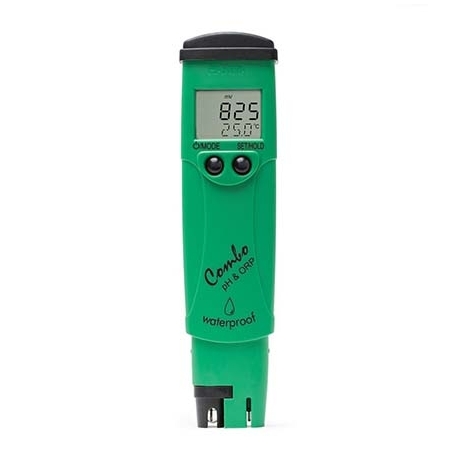
The exposed stainless steel temperature sensor on these models facilitates faster and more accurate temperature measurement.
The exposed stainless steel temperature sensor on these models facilitates faster and more accurate temperature measurement.
 Πολιτική ασφαλείας
(επεξεργασία με το Πρόσθετο Διαβεβαίωση Πελατών)
 Πολιτική παράδοσης
(επεξεργασία με το Πρόσθετο Διαβεβαίωση Πελατών)
 Πολιτική επιστροφών
(επεξεργασία με το Πρόσθετο Διαβεβαίωση Πελατών)
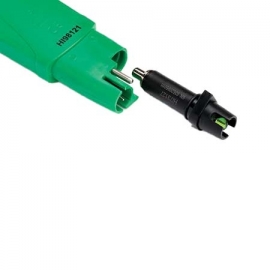
This is a waterproof pH, ORP and temperature meter. The housing of this tester has been completely sealed against humidity and is designed to float. Electrode replacement with the stainless steel round connector means there are no pins to bend or break during replacement.
This is a lightweight ergonomically designed tester. This tester is designed to float making it ideal for taking readings virtually anywhere.
By definition pH is the measurement of the voltage generated by an electrochemical cell at zero current. The potential generated is proportional to the thermodynamic activity of the ion being measured.
pH can further be described as the negative log of the concentration of hydrogen ions, pH=-log10[H+]. This is based on the fact that pure water, H2O, has an equal amount of hydrogen (H+) ions and hydroxide (OH-) ions. In pure water there is an equal amount of positive ions and negative ions, making the solution neutral. As a pH changes, there is a 10 times change in H+ concentration per pH unit.
Similar to the way acidic or alkaline solutions are quantified by pH measurements, solutions can also be classified as oxidants or reductants based on ORP measurements (sometimes referred to as "redox").
When an oxidizing and / or reducing agent is dissolved in an aqueous solution, they may react with existing materials to produce a voltage, or electromotive force (EMF), associated with the proportion of oxidized species to be reduced in the sample. Electron exchange can develop between this solution and an inert metal sensor immersed in the solution, and the voltage can be measured (compared to a reference electrode) with a pH / mV meter.
This type of measurement is known as redox or ORP. The units of measurement are in mV. At first glance, an ORP electrode may look a lot like a pH electrode. Like a pH combination electrode, both the sensor and the reference are housed in a common body.
The measurement scale can be positive (showing oxidative potential) or negative (showing reduction). It should be noted that when zero mV is observed, it is really an oxidizing state because the reference voltage (~ 200 mV for an Ag / AgCl with KCl electrolyte) is included in the observed mV value. In some cases the user may wish to offset the reading to remove the reference contribution. It is then said that mV is close to the absolute mV scale referred to as SHE (typical hydrogen electrode).
This type of calibration is called relative mV calibration. An ORP sensor must be chemically inert. can not be oxidized or reduced. It must also have the appropriate surface characteristics to promote rapid electron exchange, a property known as high exchange current density. Two noble metals have been shown to work well for this purpose: pure platinum and pure gold are both used in the manufacture of ORP sensors.
The platinum sensor is often preferred because it is mechanically simpler and safer to produce. Platinum can be bonded to glass and has the same thermal coefficient. Gold sensors cannot be welded to glass and are often mounted on plastic brackets applied to the glass or plastic tube through tiny elastomeric fins. The gold or platinum sensor signal is transmitted through the body of the electrode and together with the reference signal is led to the meter through a coaxial cable with BNC connector.
Characteristics:
Waterproof
Automatic temperature compensation
HOLD capability
Easy to use
Economic
Specifications
pH Range -2.00 to 16.00 pH
pH Resolution 0.01 pH
pH Accuracy 0.05 pH
ORP Range 1000 mV
ORP Resolution 1 mV
ORP Accuracy 2 mV
Temperature Range -5.0 to 60.0C / 23.0 to 140.0F
Temperature Resolution 0.1C / 0.1F
Temperature Accuracy 0.5C /1F
pH Calibration automatic, at one or two points with two sets of standard buffers (pH 4.01 / 7.01 / 10.01 or pH 4.01 / 6.86 / 9.18)
Temperature Compensation automatic for pH readings
Battery Type/Life 1.5V (4) / approximately 250 hours of continuous use; auto-off after 8 minutes of non-use
Environment -5 to 50C (23 to 122F); RH max 100%
Weight 100 g (3.5 oz.)
No customer reviews for the moment.